
The HireInterviewAI team builds adaptive AI technical interviews that probe candidates concept by concept and report exactly which topics they understand at depth.
Posts by HireInterviewAI Team
AI Interviewer vs. Hiring Decision Engine: The Layer That Actually Matters
AI interviewers are a commodity in 2026. The hiring decision engine — per-concept evidence, role fit, honest uncertainty — is the layer that matters.
From Résumé to Recommendation: The Anatomy of an Evidence-Based Hiring Decision
An evidence-based hiring decision is assembled stage by stage — résumé, adaptive interview, coding, design round — each contributing distinct evidence.
'Can They Code?' Is the Wrong Question
Coding tests answer 'can they solve this puzzle today'. A hiring decision needs 'should I hire this engineer for this role' — the gap is where mis-hires live.
Evidence-Based Hiring: Why Datapoints Beat Opinions
Most interview outcomes are opinions. Evidence-based hiring cites what was asked, what was answered, and the depth it demonstrated — per concept, every time.
How Knowledge Fingerprints Help Companies Find the Right Talent
Résumés show who looks right; knowledge fingerprints show who is right. How per-concept depth profiles help companies find talent that fits the role.
How to Get Discovered by Companies — Without a Referral or a Brand-Name Résumé
Stop chasing recruiters. A verified knowledge fingerprint makes employers find you — how skill-based discovery works and how to make your profile surface.
The Organization Skill Graph: What Hiring Data Should Become
When every hire arrives with a verified per-concept fingerprint, the organization skill graph follows — a living map of real strengths, gaps, and mentors.
How to Prepare for an AI System Design Interview
AI system design interviews probe one pinned problem across six dimensions at adaptive depth. How to prepare — and why memorizing architectures fails.
What Is a Verified Talent Marketplace? Hiring Where Skill Claims Are Measured
A verified talent marketplace ranks candidates by measured, per-concept skill evidence — not self-reported résumés. How it works for both sides.
What Is Competency Intelligence? (And Why Hiring Needs It)
Competency intelligence turns interviews from a gate into a measurement instrument: per-concept, evidence-backed knowledge of what a person actually knows.
Are paid skill assessments worth it for developers?
An honest look at whether a paid proctored skill assessment is worth paying for — versus free certificates and the LeetCode grind — and why proctoring is the thing you are actually paying for.
How to hire from a verified talent pool
How to source engineers by measured depth instead of self-reported skill tags — searching by concept, depth, and seniority bar in a pool where every profile is backed by a proctored assessment.
Open apply, verified ranking: how our job board works
On the HireInterviewAI job board, applying is free and open to everyone — no assessment paywall. Verification changes how you rank and how much employers trust you, not whether you can apply.
What is a knowledge fingerprint? A definition for candidates and employers
A knowledge fingerprint is a per-concept map of what a developer actually knows, built only from proctored assessments they choose and pay for — versioned over time, owned and controlled by the candidate.
AI has broken the top of your hiring funnel
Candidates now mass-apply with AI — perfect résumés, tailored cover letters, thousands per role. When every application looks great, the résumé is dead as a signal. Here's what still works.
Is your AI interview tool compliant? EU AI Act, NYC Local Law 144, and bias audits
AI hiring is now regulated. Here's what the EU AI Act, NYC Local Law 144, and bias-audit rules actually require of an AI interview tool — and the design choices that make one defensible.
The AI hiring stack: the best tools for every stage of your funnel
A stage-by-stage map of the AI hiring funnel — sourcing, ATS, screening, interviewing, and decision — with the best-known tools at each stage and where a per-concept technical interview fits.
AI interview proctoring that gives you evidence, not a verdict
Inside HireInterviewAI's proctoring — three deployment tiers, reviewable evidence for every flag, and a deliberate refusal to falsely accuse good candidates.
Are AI interviews fair? An honest answer about bias in AI hiring
Whether an AI interview is fair depends on its design — what it scores, whether its output is explainable, and who makes the decision. Where bias actually comes from, and what fairness requires.
Everyone ships with Copilot now. Can your candidate actually engineer?
AI coding assistants make almost anyone look productive — so shipped output no longer proves understanding. Here's how to assess whether an engineer can actually reason about systems, not just prompt.
Deepfakes, proxies, and fake candidates: the remote hiring fraud you're not screening for
Remote interview fraud has gone industrial — deepfake video, voice clones, identity proxies, and paid stand-ins. Here's what to screen for and how evidence-first proctoring catches it.
What is per-concept skill scoring? A definition for hiring teams
Per-concept skill scoring measures a candidate's depth on each individual concept a role requires — instead of one blended score. The definition, how it's measured, and what it changes.
How to interview an AI Agent engineer: a concept-by-concept guide
How to interview an AI agent engineer concept by concept — the agentic loop's exit semantics, tool description contracts, the agent-vs-workflow decision, context rot and compaction, trajectory evaluation, and agent security — to measure real depth, not framework-quickstart recall.
How to interview an AI Engineer: a concept-by-concept guide
How to interview an AI engineer concept by concept — what temperature really changes, chunking as a quality lever, LLM-as-judge biases, RAG vs long context vs fine-tuning, LoRA/QLoRA mechanics, and the memory-bound KV cache — to measure real depth, not model-card recall.
How to interview a FastAPI developer: a concept-by-concept guide
How to interview a FastAPI developer concept by concept — dependency injection, Pydantic response boundaries, yield dependencies, the OAuth2/JWT flow, and the blocked event loop — to measure real depth, not tutorial recall.
How to interview a Python developer: a concept-by-concept guide
How to interview a Python developer concept by concept — the object model, the data model, generators, decorators, EAFP, and the GIL — to measure real depth, not syntax recall.
How to interview a Kubernetes engineer: a concept-by-concept guide
How to interview a Kubernetes engineer concept by concept — reconciliation, scheduling, networking, RBAC, and security probes that separate real depth from kubectl fluency.
Adaptive Technical Interviews Explained — Finding a Candidate's True Ceiling
An adaptive technical interview adjusts difficulty in real time to find each candidate's true ceiling per concept — how depth-probing works and why it wins.
Best AI interview tools for technical hiring (2026 guide)
A fair guide to the best AI interview tools for technical hiring — how coding assessments, video screening, skills tests, and adaptive interviews compare.
How to Assess Developer Skills — A Concept-by-Concept Framework
A practical framework for how to assess developer skills: define the concepts a role needs, probe each to its ceiling, and score depth instead of vibes.
How to interview a backend developer: a concept-by-concept guide
How to interview a backend developer concept by concept — APIs, databases, concurrency, system design, reliability — to measure true depth, not vibes.
How to test Go concurrency knowledge in an interview
How to test Go concurrency knowledge with real interview probes — goroutines, channels, context, the data race — and tell mastery from confident bluffing.
How to prevent cheating in technical interviews (remote era)
To prevent cheating in technical interviews you need proctoring plus live adaptive depth probing — static tests leak, but a true-ceiling probe is hard to fake.
How an automated first round technical interview actually works
An automated first-round technical interview cuts calendar drag and interviewer variance, reporting per-concept depth so you meet only real candidates.
The False-Negative Problem — Reducing False Negatives in Technical Hiring
Reducing false negatives in technical hiring starts with how you measure. Here is why good engineers fail interviews and how per-concept depth fixes it.
How to prepare for an AI technical interview: what to expect
How to prepare for an AI technical interview — what an adaptive, proctored AI interview is really like, why it gets harder, and how to show your true depth.
Why a 6.5/10 backend score is useless — and what per-concept skill scoring shows instead
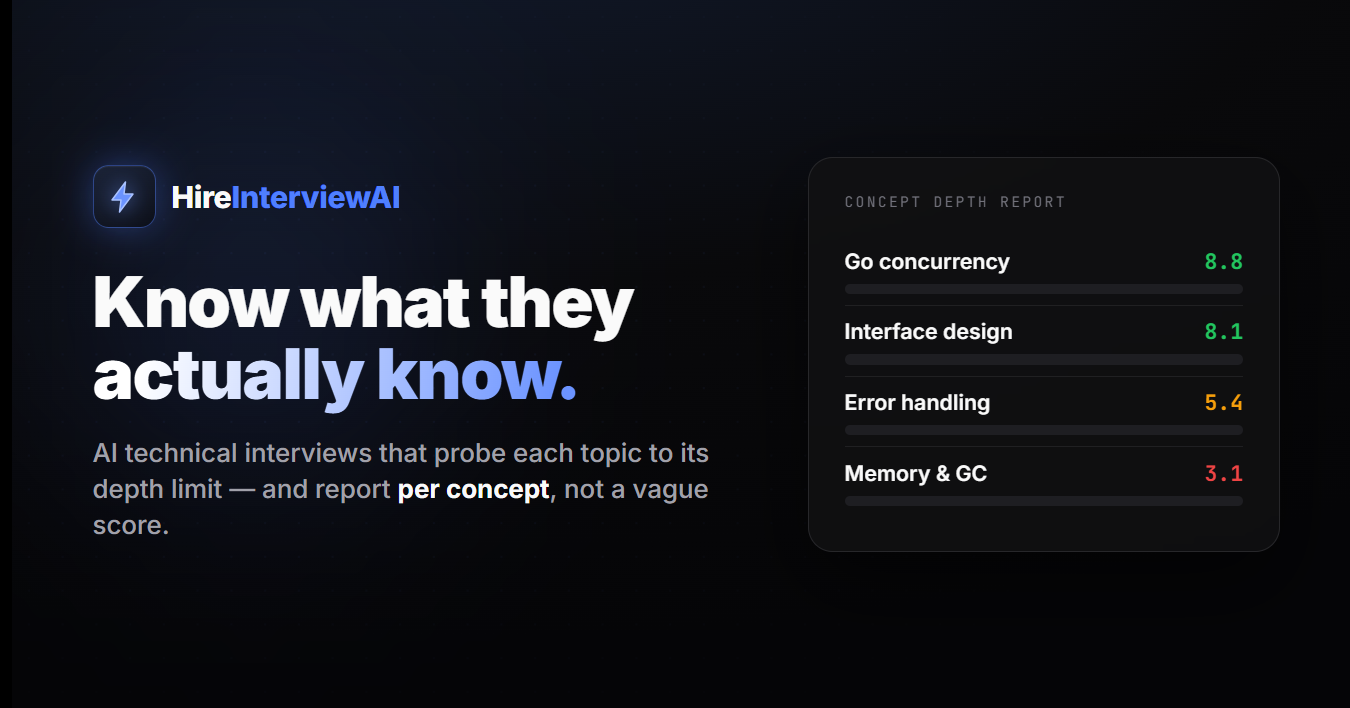
A single "backend 6.5/10" hides the one thing you need to hire well. Here is why per-concept skill scoring beats one number, and how to read it.